

By Jack Cranmer
The United States has hosted the World Cup before. In 1994 the tournament helped launch Major League Soccer and pushed the sport further into the American mainstream.
Now, three decades later, the World Cup returns to North America, shared between the United States, Canada and Mexico, and the question is no longer whether soccer belongs in America.
The question now is whether the tournament could spark a second golden age.
To understand that possibility, it helps to look back to the moment American soccer first captured the national imagination.
Pele is arguably the greatest footballer of all time, and undoubtedly one of the most influential.
A three-time World Cup winner, he claimed his first title at just 17 years old. He became an icon of Brazilian football through his legendary exploits with the national team and his extraordinary career with Santos.
Pele played for Santos from 1956 to 1974, scoring an astonishing 643 goals in 659 competitive appearances. By the time he retired in 1974, he had firmly established himself as a one club legend, seemingly riding off into the sunset.
Until the Summer of 1975.
In a move that stunned the football world, Pele came out of retirement to join the New York Cosmos of the North American Soccer League. It was not simply a transfer. It was a cultural moment that reached far beyond sport.
Football had arrived in America.
Pele’s First Steps
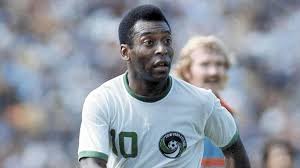
The man himself once said: “I knew when I came here that I had a responsibility, not only to play, but to help the sport grow.
“The United States has everything to become a great soccer nation.”
Backed by media giant Warner Communications, the Cosmos saw in Pele not only a footballing genius but a global icon who could give instant credibility to the fledgling American soccer scene.
At 34 he was past the typical peak years for most athletes of the era, but he still dazzled crowds with his flair, vision and charisma.
People simply wanted to see him.
At the time, soccer remained a niche sport in post war America. It was played largely within immigrant communities and received little national attention.
Charles Cuttone saw that reality up close. When he joined the Cosmos in the early 70’s as a 13-year-old staff helper, he knew almost nothing about the sport.
The American football team he had worked for had folded, and the Cosmos happened to play in the same stadium on Randalls Island.
“When I started working for the Cosmos, I knew little to nothing about soccer,” Cuttone recalled.
“There was very little coverage in the newspapers, and you very rarely saw it on television.”
His early tasks reflected the state of the league. For Pele’s debut, the pitch at Downing Stadium was in such poor condition that officials feared the Brazilian might cancel his agreement after seeing it.
Cuttone was sent onto the field with a bucket and brush to paint the grass green and make the surface look presentable.
Interestingly, Pele was not even the Cosmos first choice superstar.
Their original target was Manchester United legend George Best. The deal might have happened had Best not skipped a scheduled press conference in New York after disappearing on one of his infamous drinking binges.
Cosmos historian David Kilpatrick later reflected on the moment.
“We do not quite know what happened, but something caught his eye in Manhattan that kept him from showing up,” he speculated.
Everybody thought George Best was going to be a Cosmos player.”
Instead, the club turned its attention to Pele.
European giants also attempted to sign him. According to Cuttone, clubs like AC Milan and Real Madrid were interested.
But Cosmos executive Clive Toye reportedly delivered the pitch that changed everything.
“If you go to Europe, you can win championships. If you come to the United States, you can win a country,” he told the icon.
The lucrative financial package of course helped too.
Culture of Personality

The impact was immediate. On the day Pele signed his contract, the announcement was made at a press conference in the famous 21 Club in Manhattan.
The room was so overcrowded that some members of the Cosmos staff, including PR team member Cuttone, could not even enter.
“There had never been anything like it in US soccer,” Cuttone said.
“The room was way too small. No one expected it to be that big, but it was only the start.”
Later that day the Cosmos played away to the Philadelphia Atoms. More than 20,000 fans attended, a remarkable figure for the NASL at the time. Many were simply hoping to catch a glimpse of Pele in the stands.
A week later he made his debut in a friendly against the Dallas Tornado at Downing Stadium.
Among the crowd was Nicholas Koliarakis, the son of a Greek father and Brazilian mother.
Soccer had only recently become his favourite sport, but there was no chance he was missing such a moment.
He travelled to the match with family and friends, sitting through heavy traffic four hours simply for the opportunity to see Pele in person.
What he remembered most was the atmosphere. The sense that something new had arrived in New York sport.
Another early Cosmos supporter was Lee Zakow. Growing up in Queens as the grandson of Russian and Polish immigrants, he played soccer with other neighbourhood kids from immigrant families.
When he discovered a professional team in New York playing in the NASL, he quickly became fascinated.
“The New York Post might have a tiny blurb on a Monday,” Zakow said.
“That was it. No TV, no press. You might occasionally see something short in Sports Illustrated about players like Kyle Rote or Bobby Rigby.”
Then Pele arrived.
“And the whole thing exploded.”
Zakow attended matches regularly, including the 1977 Soccer Bowl which would be Pele’s final competitive match. The stadium was full, though many in the crowd were still newcomers to the sport.
Soccer was growing, but it was still finding its place.
For others, the impact lasted far beyond the NASL era.
Kilpatrick remembers owning a Pele themed lunchbox as a child.
Even after moving to Tennessee in 1976, he remained a devoted Cosmos supporter.
“When I was a kid flying across the country, you would see baseball diamonds everywhere,” he said.
“Now you see soccer pitches. Every village in the US has one.
“Pele made soccer part of pop culture. You could not watch television without seeing those black and white Telstar balls.”
Fall and Rebirth
After Pele retired in 1977 the Cosmos continued to attract global stars including Carlos Alberto, Johan Cruyff, Giorgio Chinaglia and Franz Beckenbauer.
But overexpansion and financial problems eventually brought the NASL down. The league folded in 1984, and the Cosmos disappeared soon after.
Yet the legacy remained.
In 1991 Zakow helped organise a Cosmos reunion match backed by Time Warner, who he worked for at the time.
Through family connections he joined the organising team and helped track down former players, coordinate media and secure sponsors.
The event reunited stars from across the club’s history, including Carlos Alberto and Ricky Davis. Zakow also spent time with Pele himself.
“He might have been a king,” Zakow said, “but he was a benevolent king.”
The Cosmos briefly returned in 2013 as part of a revived NASL, even winning championships in 2013, 2015 and 2016.
But they could never recreate the glamour of the 1970s. Big names like Raul and Marcos Senna came and went, yet none could replicate the magic of Pele.
The club has been on hiatus since 2021, caught in legal disputes and overshadowed in New York by Major League Soccer teams New York City FC and the Red Bulls.
Still, the memory of what the Cosmos once represented remains powerful.
“Would there have been a 1994 World Cup or MLS without Pele?” Cuttone asked.
“Unequivocally not. You can connect the dots.
“The operation was a success, but the patient died.”
He compared the Brazilian’s impact to other transformational sporting figures: “Babe Ruth was the big bang for baseball. Magic and Bird for basketball. Gretzky for hockey. Pele was the big bang of soccer.”
Zakow agrees. “It does not happen without Pele,” he said.
“The sport would have grown eventually, but much slower.”
Coming Full Circle

Fifty years later, the effects of that original spark are visible everywhere.
Youth participation across the United States has exploded. MLS has expanded into a stable top tier league. International stars continue to arrive.
Now the World Cup returns to North America.
This time the United States does not need a single global superstar to introduce the sport.
The foundations are already in place. Stadiums are ready. Television audiences are growing and a new generation of American players compete regularly in Europe’s top leagues.
In 1975 Pele came to America with a promise that soccer could win the country.
This Summer the World Cup offers the chance to prove that it already has.


 UWS Newsroom